How to Build a Size Chart for Dropshipped Women's Clothing
Try Stylesi freeA size chart for dropshipped clothing has one job: make the size on your product page mean the same thing as the size on your customer's body. Suppliers often send a chart that does not. It may list measurements of the garment itself, use Asian sizing, or leave the units out. Shopify's sizing guide cites a Coresight Research survey that found size and fit were the top reason for 53 percent of returns, so a chart you can trust protects your margin. This guide shows how to read a supplier chart, works through a wrap dress example, gives you six checks to run before you publish, and says what to do when the chart cannot be trusted.
Garment measurements and body measurements are different things
The same Shopify guide describes two kinds of chart. A body chart matches each size to body dimensions such as bust, waist and hip, so shoppers can compare the numbers with their own tape measure. A garment chart lists the dimensions of the product itself. A supplier chart can be either one, and it often does not say which.
What separates them is ease, the room built into a garment so the wearer can move and breathe. A woven dress needs more ease than a stretch knit, and a loose style needs more than a fitted one. A chart that says bust 92 cm tells you about the dress if it is a garment chart, and about the customer if it is a body chart. Mix them up and every size is off by the ease.
Laid-flat measurements add a second trap. A tape measure across the front of a dress from underarm to underarm gives half the circumference, so a flat bust of 46 cm means a 92 cm dress. If a chart lists a bust of 46 cm for a medium, it is almost certainly a flat measurement, because a 46 cm bust circumference would fit a child.
A worked example: one wrap dress, three readings
Say a supplier lists a woven wrap dress with these bust measurements and no label: S 88, M 92, L 96 and XL 100, all in centimetres. There are three ways to read the numbers.
Read as body measurements, an M fits a bust of 92 cm. Read as flat garment measurements, an M would have a 184 cm bust, which is impossible, so you can rule that out. Read as full-circumference garment measurements, an M dress has a 92 cm bust, and the wearer needs room inside it.
The way to settle it is to order a sample, lay it flat, measure underarm to underarm and double the result. If you get 92 cm, the chart describes the garment. A bust ease of about 6 cm is a common starting point for a woven dress that is not meant to cling. Stretch knits need less, and guides differ, so treat 6 cm as a rule of thumb and confirm it on the sample. With 6 cm of ease, the garment chart translates into a chart for the body.
| Size | Garment bust | Fits body bust up to |
|---|---|---|
| S | 88 cm | 82 cm |
| M | 92 cm | 86 cm |
| L | 96 cm | 90 cm |
| XL | 100 cm | 94 cm |
Now see what the table changes. A customer with a 92 cm bust, who would pick an M from the supplier's list, actually needs the XL. If you had published the supplier's numbers as a body chart, she would order the M, receive a dress with a 92 cm bust, and probably return it. That return is the one a correct chart prevents.
How to measure a sample so the numbers are comparable
Measure the same way every time, or your own numbers will drift. Lay the garment flat on a table and smooth it without stretching. For the bust, measure straight across from underarm seam to underarm seam, then double it. For the waist, measure across at the narrowest point and double it. For length, measure from the highest point of the shoulder to the hem, and write down where you started.
Record each size you measure in a small sheet with the date and the supplier's listed number next to it, and photograph the tape across the garment. The photo settles an argument later, whether it is with a supplier about a bad batch or with yourself about which point you measured. Measure at least the size you expect to sell most, and check a second size if the steps between sizes looked uneven.
Six checks for a supplier size chart
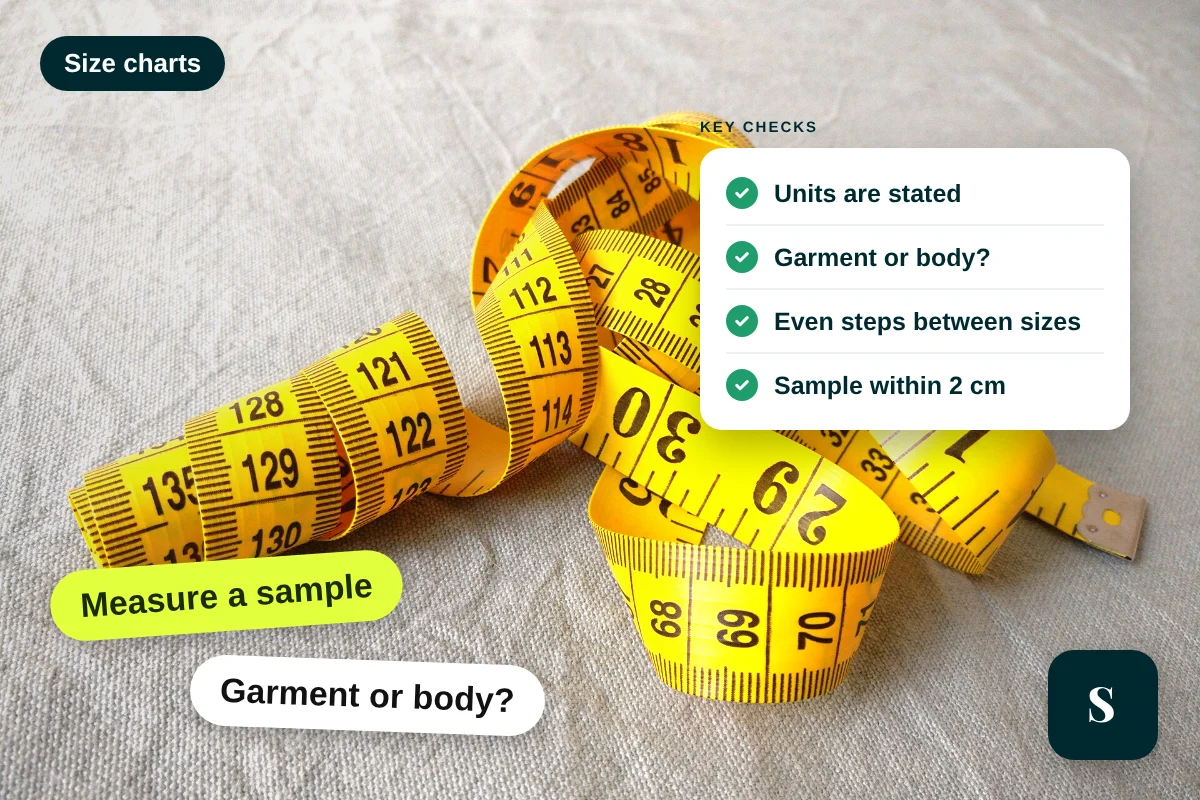
Before you publish any chart, run it through six checks. Each is a clear pass or fail. A failed Type or Sample check, or any two failures, means the chart is not ready.
| Check | Pass | Fail |
|---|---|---|
| Units | cm or inches stated | No unit shown |
| Type | Says garment or body | Says neither |
| Points | Says where each is measured | Only the word "bust" |
| Steps | Sizes rise in even steps | Jumps of 1 cm, then 8 |
| Fabric | Woven or stretch stated | No fabric information |
| Sample | Your measurement matches | More than 2 cm off |
The steps check catches copy-and-paste errors. If sizes S to XL rise by 4 cm each, the chart is at least consistent with itself. If one step is 1 cm and the next is 8 cm, someone typed a number wrong, and you should not trust the other numbers either.
What to publish when the chart is not clear
Your next step depends on what the chart says about itself.
| Supplier chart | Publish | Next step |
|---|---|---|
| Garment measurements | Garment and body columns | Add ease, check a sample |
| Body measurements | As given, labelled body | Spot check one size |
| Neither stated | Nothing yet | Measure a sample or skip |
The last row is the hard one. If you cannot find out what the numbers mean, the honest choice is to measure a sample or leave the style out. A product you cannot size is a return waiting to happen, and it can cost more than the profit on the order.
Stretch fabrics follow a different rule
Everything above assumes a woven dress that does not give. A stretch knit changes the picture, because the same garment fits a range of bodies and the ease can be zero or even negative. Measure a knit relaxed, then stretch it gently across the same point until it feels comfortable rather than strained, and note both numbers. A chart for a knit works best as a range, such as the body bust it fits comfortably, plus a line saying the fabric stretches.
If a supplier lists a single set of measurements for a knit and says nothing else, the six checks still apply. Treat the type and the fabric rows as the ones most likely to fail, since they are the two a supplier forgets to mention.
Add the fit notes a chart cannot carry
Numbers do not tell a shopper how a dress behaves. Add a short fit note to each product: whether the fabric is woven or stretch, where the hem falls on the body, and whether the style runs small if your sample showed that. Only state what you checked yourself, because a made-up note such as "true to size" is worse than none. Shoppers can read a note against their own body in seconds, and a clear note answers the question before it becomes a support email.
Photos help in the same way. A flat photo of the garment with the measure points marked shows what "bust" and "length" mean for this style, and it saves you from explaining it in words.
Publish the chart where customers choose a size
Put the chart next to the size selector, not three clicks away, and label the variants with the same sizes the chart uses. If your store sends products to Google, Merchant Center asks for the same information. Google's help page says the size attribute is required for free listings of products in Apparel & Accessories > Clothing, and the page on the size type attribute says to use it to describe the cut of a product, with values such as petite, plus, tall or maternity. Consistent size labels in your store and your feed mean fewer mismatches.
Keep the chart simple enough to read on a phone. Use one row per size and one column per measurement, print the unit in each column heading, and limit it to the measurements that decide fit for that style, usually bust, waist, hip and length. A chart with twelve columns gets skipped, and a skipped chart is the same as no chart.
Test the chart against your returns
A chart is a hypothesis until customers use it. When a return comes in, record the reason, and look at the sizes. If two returns in a row for the same style say it ran small, change the chart before the next order, and recheck the sample. Over a few months the style notes you add from returns will usually do more for fit than a generic template.
If you sell women's fashion, importing the product is the easy part, and the chart is the part you still check yourself. Stylesi imports a style to Shopify in one click with photos and a description, hides sold-out sizes through stock sync, and shows the cost, the selling price and your profit before you import. You can try Stylesi and run the six checks above on a sample before you list.
Size chart FAQs
Should I use inches or centimetres?
Use the unit your customers use, and add the other in brackets if you sell in several countries. Never mix the two in one column, and always print the unit in the column heading.
Do I need a chart for stretch fabric?
Yes, although stretch forgives small errors. State that the fabric stretches and publish a range, so shoppers can judge the fit from their own measurements.
What if the supplier chart uses Asian sizing?
Ignore the size letters and work from the measurements. Check them with a sample, then build your own chart from the numbers you confirmed rather than relabelling the supplier's sizes.
How many sizes should I measure?
Measure the size you expect to sell most, and a second one if the steps between sizes looked uneven. If both match the supplier's chart, the rest of the chart is probably consistent.
We help Shopify sellers find, list and sell trending women's fashion, with practical guides on suppliers, sizing, pricing and fulfilment.
